

If you’ve been reading about digital marketing lately, you’ve probably come across three acronyms that seem to be everywhere: SEO, AEO, and GEO.
Some articles suggest SEO is becoming obsolete. Others claim businesses should only focus on AI search. Then there are agencies offering everything from ChatGPT Optimization Services to Generative Engine Optimization Services, making it difficult to know where to invest.
So, are these three strategies different, or are they simply different names for the same thing?
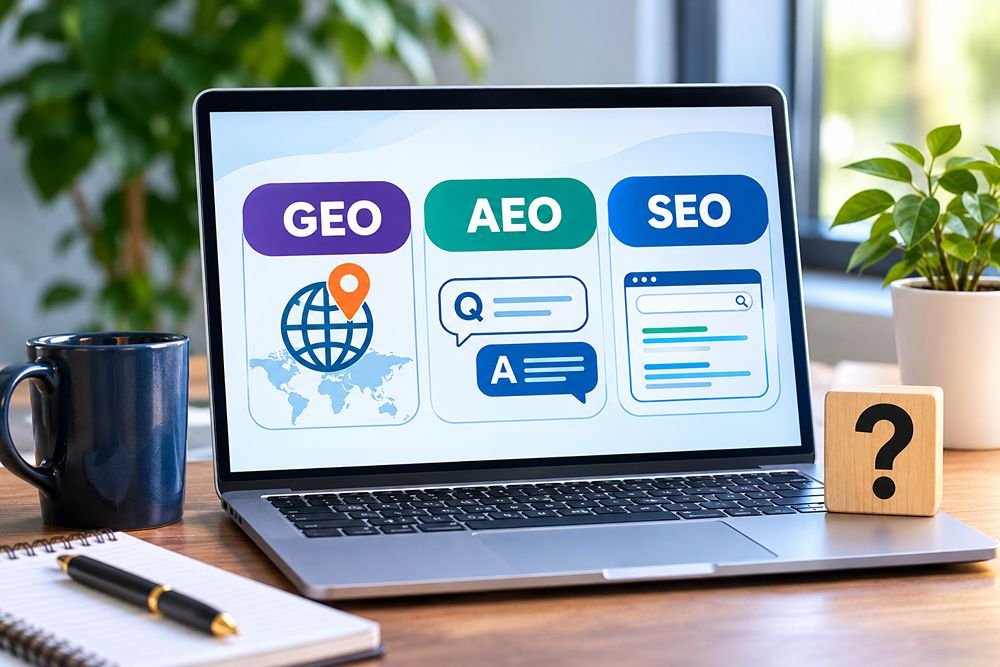
The short answer is they are connected, but they serve different purposes. Understanding how they work together can help you build a stronger online presence instead of chasing every new trend.
Let's Define Each One
Before comparing them, it’s important to understand what each strategy is designed to achieve.
SEO (Search Engine Optimization)
SEO focuses on improving your website’s visibility in traditional search engines like Google and Bing.
Its primary goal is to help your pages rank for relevant searches by improving:





SEO remains the foundation of digital visibility because search engines still drive a significant percentage of online traffic.
If you’re unfamiliar with the basics, our guide on On-Page SEO Essentials: Boost Your Web Pages to the Top explains how page optimization continues to influence rankings.
AEO (Answer Engine Optimization)
Answer Engine Optimization is designed to help your content become the direct answer to a user’s question.
Instead of simply ranking on a search results page, AEO focuses on appearing in places such as:
- Featured snippets
- Voice search responses
- Google’s answer boxes
- AI-generated summaries that provide concise answers
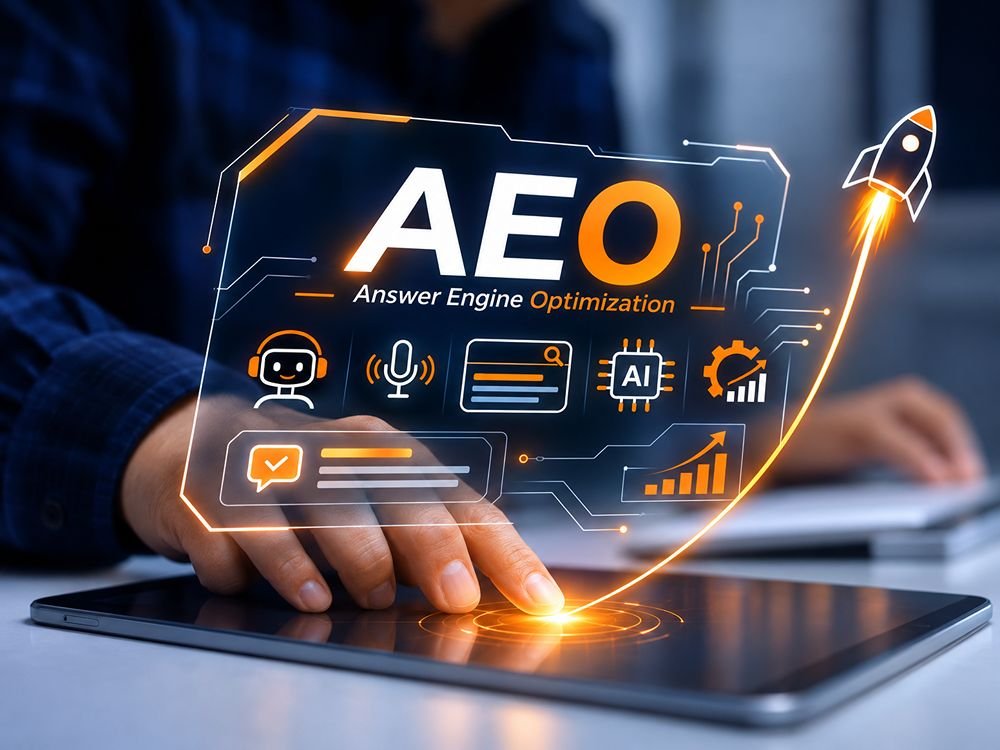
Good Answer Engine Optimization Services prioritize clear explanations, structured content, FAQ sections, and concise responses that search systems can easily understand.
GEO (Generative Engine Optimization)
Generative Engine Optimization is one of the newest developments in search marketing.
Rather than optimizing only for search rankings, GEO focuses on helping AI-powered platforms understand, trust, and reference your content.
Examples include:
- Google AI Overviews
- ChatGPT
- Microsoft Copilot
- Perplexity AI
- Gemini
Businesses working with an AI Search Optimization Agency often aim to improve how AI systems discover, interpret, and cite their content.
Unlike traditional rankings, AI systems frequently generate answers by combining information from multiple trusted sources.
A Simple Way to Think About It
Imagine you’re opening a new restaurant.
- SEO helps people find your restaurant on Google.
- AEO helps Google recommend your restaurant when someone asks a specific question.
- GEO helps AI assistants mention your restaurant while generating an answer.
Each serves a different purpose, but none replaces the others.
Why SEO is Still the Foundation
In fact, AI systems rely heavily on well-optimized websites to gather reliable information.
A website with poor technical performance, outdated content, or confusing navigation is unlikely to perform well in either traditional search or AI-generated experiences.
This is why Search Engine Optimisation Services remain essential even as AI search evolves.
Businesses should continue investing in:
- Fast-loading pages
- Helpful content
- Mobile-friendly design
- Clear internal linking
- Technical website health
Many of these improvements also support AI-driven search visibility.
Where GEO and AEO Add Value
As more people ask conversational questions like:
“What’s the best CRM for small businesses?”
or
“How can I improve local SEO?”
AI systems increasingly summarize information instead of displaying only website links.
Businesses using Generative Engine Optimization Services focus on creating content that is:
- Well-structured
- Factually accurate
- Easy to reference
- Written with clear expertise
Similarly, ChatGPT Optimization Services often emphasize topical authority, content clarity, and trustworthy sources instead of simply targeting keywords.
If you’re interested in how AI is changing search behavior, our article How AI SEO is Changing the Way Google Understands Content in 2026 provides additional insight into this evolving landscape.
As AI-powered search continues to evolve, businesses need to understand how their content can appear in AI-generated responses. According to Google’s official guidance on AI features and your website, traditional SEO best practices remain relevant for AI Overviews and AI Mode. Google also confirms that no special optimization is required to appear in these features. This reinforces why businesses should prioritize helpful content, technical accessibility, and reliable information rather than relying on AI-specific shortcuts.
Do Small Businesses Need All Three?
The answer depends on your goals.
If you’re a local business just beginning your online marketing efforts, building a strong SEO foundation should come first.
Once your website demonstrates authority and consistently publishes valuable content, incorporating AEO and GEO strategies becomes much more effective.
Trying to optimize for AI before establishing credibility is similar to promoting a book that hasn’t been written yet.
Businesses working with a Digital Marketing Agency should look for a strategy that integrates all three rather than treating them as separate services.
What Does Google Actually Recommend?
Whether your content appears in traditional search, featured snippets, or AI Overviews, Google’s guidance remains remarkably consistent. The official Google Search Central documentation on creating helpful, reliable, people-first content reinforces that content should be written primarily for users rather than search engines, with a strong focus on expertise, originality, and usefulness.
Rather than writing for algorithms, businesses should focus on:
- Answering genuine customer questions
- Demonstrating expertise
- Citing trustworthy information
- Updating outdated content
- Creating an excellent user experience
These principles align closely with Google’s E-E-A-T framework and support visibility across multiple search experiences.
Our article How Can Your Business Get Mentioned in Google AI Overviews? explores practical ways businesses can improve their chances of appearing in AI-generated search experiences.
Common Misconceptions
Not at all. Without strong SEO fundamentals, GEO has very little reliable content to build upon.
Voice search contributed to AEO’s growth, but answer engines now include featured snippets, AI summaries, and conversational search interfaces.
AI systems increasingly prioritize information that appears accurate, trustworthy, and well-supported. Thin or low-quality content is less likely to become a referenced source.
Which Strategy Should You Prioritize?
| Strategy | Primary Goal | Best For |
| SEO | Improve traditional search visibility | Long-term organic traffic |
| AEO | Answer user questions directly | Featured snippets, voice search, answer boxes |
| GEO | Increase visibility in AI-generated responses | AI search platforms and conversational assistants |
For most businesses, the roadmap is straightforward:
- Build a technically strong website.
- Create helpful, experience-driven content.
- Optimize pages for clear answers.
- Strengthen authority across your niche.
- Adapt content for emerging AI search experiences.
This layered approach is far more sustainable than chasing every new algorithm update.